Creamy Scrambled Eggs: Achieving the Velvet Standard
Transcend the rubbery, industrial textures of conventional cooking. Low-temperature coagulation technique for exceptionally creamy, French-style scrambled eggs.
Introduction: Transcending the Rubbery Standard
When you envision scrambled eggs, what is the immediate sensory profile? For many, it is a utilitarian heap of desiccated, rubbery yellow fragments, subjected to a rapid, high-heat ordeal in a searing pan. This is the industrial default, the hallmark of the hurried breakfast. It is time to refine that perception.
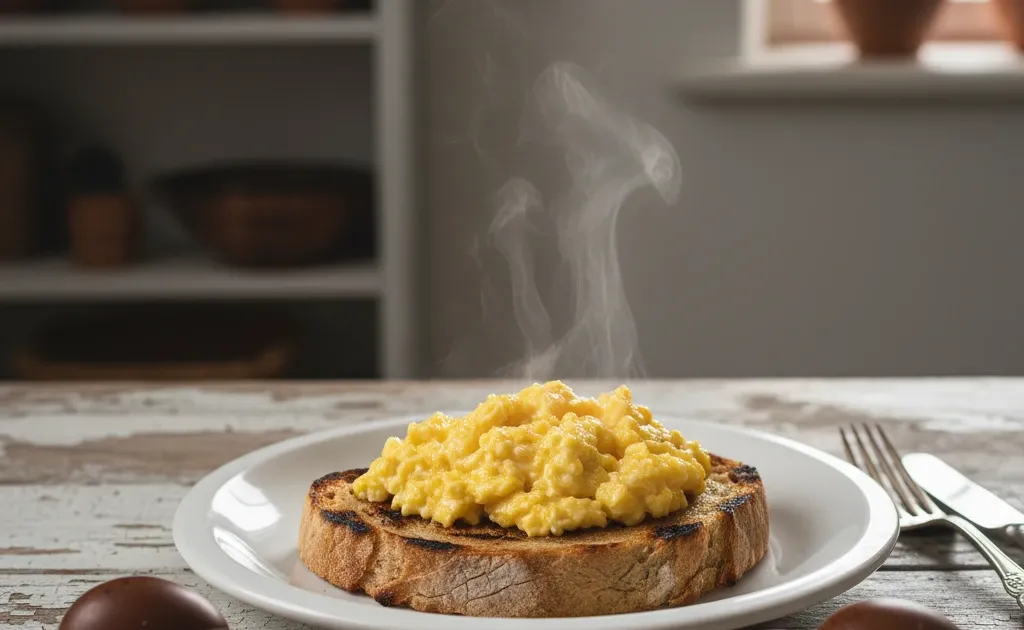
There exists a parallel gastronomic universe where scrambled eggs are transformed from a rustic staple into a sophisticated masterpiece of molecular textures—a preparation worthy of a five-star haute cuisine establishment. We are referring to creamy scrambled eggs, often termed uova strapazzate alla francese. Their structural integrity is entirely different: rather than solid curds, they present as a soft, velvet-smooth emulsion—a fine, moist, and incredibly rich matrix that dissolves upon the palate.
This guide explores the technical precision required to achieve this standard. It is not an inherently difficult process, yet it demands a fundamental shift in methodology: an abandonment of haste and violent thermal loads. Success is a product of patience and the application of biochemical principles to transform simple proteins into a luxurious experience.
The Golden Rule: Thermal Control and Constant Agitation
The non-negotiable dogma for perfect scrambled eggs is the absolute control of temperature. High flames are the enemy of delicate proteins. The transition from liquid egg to a silken cream must occur through a gentle, gradual coagulation process.
- The Methodology: Utilise a heavy-bottomed saucepan (which ensures superior thermal distribution) or a high-grade non-stick pan. Set your hob to the lowest possible heat setting. The process should be slow, almost meditative. The eggs must never “sizzle” or reach the point of browning.
- Agitation: As the eggs warm gently, they must be subjected to constant agitation using a silicone spatula or a wooden spoon, continuously scraping the base and the perimeters of the vessel. This persistent motion prevents the formation of large, tough curds, instead encouraging the development of a myriad of microscopic curds suspended in a rich sauce of the egg’s own making.
This duality—minimal thermal load combined with constant mechanical agitation—is the biochemical heart of the technique.
The Lipid Synergy: Cold Butter and Double Cream
To further elevate the mouthfeel and flavour profile, two lipid sources are technically essential.
- Cold Butter: Resist the impulse to melt the butter beforehand. Incorporate the eggs (lightly whisked with a fork, salt, and pepper) into a cold saucepan, then add cubes of cold butter. As the butter melts gradually alongside the eggs, it creates a stabilised emulsion that is exceptionally rich from the very onset of the cooking process.
- Double Cream (or Crème Fraîche): Incorporating a tablespoon of double cream or crème fraîche at the terminal stage, away from the heat, is the professional’s final touch. This not only adds a layer of luxurious richness but also serves a technical purpose: it immediately lowers the temperature, arresting the coagulation process and preserving the delicate moisture of the matrix.
Technical Protocol: Achieving the Velvet Matrix
Ingredients (per serving):
- 2 or 3 extra-fresh pasture-raised eggs
- 15–20g high-quality unsalted butter, chilled and cubed
- 1 tablespoon double cream (optional)
- Fine sea salt and freshly cracked black pepper
Procedure:
- Crack the eggs into a bowl. Whisk gently with a fork just enough to integrate the yolks and whites. Season with salt and pepper.
- Place the cold saucepan on the hob. Introduce the eggs and the cubed cold butter.
- Initiate the lowest possible heat. Immediately begin stirring with a silicone spatula, without cessation, meticulously clearing the base and sides.
- Maintain this patient agitation. For several minutes, the mixture will appear unchanged. Then, gradually, the proteins will begin to denature and thicken. You will observe the formation of soft, microscopic curds.
- Continue stirring. The consistency will eventually resemble a very soft, warm custard. This stage typically requires between 5 and 10 minutes of controlled thermal exposure.
The Critical Threshold: Managing Residual Thermal Carryover
This is the most crucial stage, separating professional execution from domestic mediocrity. Eggs continue to coagulate even after removal from the heat source due to the energy retained within the vessel—a phenomenon known as residual thermal carryover.
The Technical Finish: You must remove the saucepan from the heat one moment before the eggs reach your desired final consistency. They should appear slightly too fluid, almost “undercooked.” This is the precise threshold. Remove from the heat, stir in the double cream to halt the cooking process further, give one final vigorous whisk, and serve immediately. In the transit from pan to plate, the eggs will reach their peak velvet state. If they look “done” in the pan, they will be overcooked on the plate.
Conclusion: A Transformed Gastronomic Experience
The result of this technical rigour is not merely a meal; it is a sensory revelation. The rich, moist, and silken texture, which quite literally dissolves upon the tongue, bears no relation to the industrial versions of the past.
Mastering the technique of creamy scrambled eggs is an act of elevating a humble protein to a level of surprising refinement. It is a minor luxury that transforms a breakfast, brunch, or a swift evening meal into a moment of pure culinary excellence.