Soft-Boiled vs. Jammy Eggs: Timing and Texture
Liquid gold or velvety cream? Discover the precise biochemical differences between soft-boiled and jammy eggs, with exact timings for culinary perfection.
Introduction: Liquid or Velvety? A Matter of Seconds
In the sphere of egg cookery, two preparations reign supreme for their understated elegance and nutritional integrity: the soft-boiled egg (uovo alla coque) and the jammy egg (uovo barzotto). Both celebrate the sublime indulgence of a yolk that has escaped full coagulation, yet they are distinguished by a subtle, vital threshold—a difference measured in a mere sixty seconds that fundamentally alters the protein structure and mouthfeel.
Often conflated, these two methods offer entirely distinct gastronomic experiences. On one hand, we have the triumph of the truly liquid yolk, designed for the quintessential British “dipping soldier”; on the other, the sophisticated equilibrium of a dense, fondant-like core.
This guide is designed to resolve the ambiguity of the boiling pot. We shall explore the technical differences between soft-boiled and jammy eggs and, crucially, provide the precise timings required to achieve your desired viscosity with scientific repeatability.
What is a Soft-Boiled Egg? The Liquid Gold Standard
The soft-boiled egg (traditionally oeuf alla coque) is the essence of culinary minimalism. The term “coque” refers to the coquille or shell, as the egg is traditionally served and decorticated within its own natural vessel.
- Textural Profile: The albumen (white) is only just set—delicate, opaque, and tender—yet firm enough to encapsulate its treasure: a liquid yolk that is warm, vibrant, and entirely free-flowing.
- Precision Timings: To achieve this result, temporal accuracy is paramount. Calculating from the point of a rolling boil, the duration must be between 3 and 4 minutes.
- 3 Minutes: For a very tender, translucent white and a completely fluid yolk.
- 4 Minutes: For a more resilient white while maintaining a pristine liquid yolk.
What is a Jammy Egg? The Fondant Equilibrium
The jammy egg (known as uovo barzotto in Italian tradition) is the more structured, mature sibling of the soft-boiled variety. The term barzotto implies “semi-cooked,” perfectly describing its hybrid biochemical state.
- Textural Profile: The albumen is fully coagulated and firm, much like a hard-boiled egg. The yolk, however, is a masterpiece of thermal balance: it is no longer liquid, but has achieved a dense, velvety, and marmalade-like consistency. In modern gastronomy, this is the coveted “jammy” state.
- Precision Timings: To reach this “jammy” threshold, the boiling time (again, calculated from the onset of the boil) extends to 5–6 minutes.
- 5 Minutes: For a core that remains slightly fluid at the very centre, surrounded by a thick, creamy mantle.
- 6 Minutes: For the definitive jammy egg—a yolk that is entirely creamy, homogenous, and fondant-like.
The Professional Technique: Fundamental Steps
To ensure consistent results and structural integrity, we recommend the cold-water start method, which minimises the risk of shell fractures due to thermal shock.
- Placement: Place your eggs (ideally at room temperature to prevent internal tension) in a single layer at the base of a heavy-bottomed saucepan.
- Immersion: Cover with cold water until the eggs are submerged by at least 2–3 centimetres.
- Thermal Ascent: Place over high heat and bring the water to a vigorous, rolling boil.
- The Chronometer: The moment the boil is reached, slightly reduce the heat to maintain a steady simmer rather than a turbulent boil, and start your timer immediately.
- For Soft-Boiled: 3–4 minutes.
- For Jammy/Medium-Boiled: 5–6 minutes.
- Thermal Shock: Upon the expiry of the timer, use a slotted spoon to transfer the eggs instantly into an ice bath or under a cold running tap. This halts the residual heat from further denaturing the proteins, ensuring the yolk remains at your desired viscosity.
Traditional Service and Gastronomic Pairing
The service of these eggs highlights their divergent structural roles.
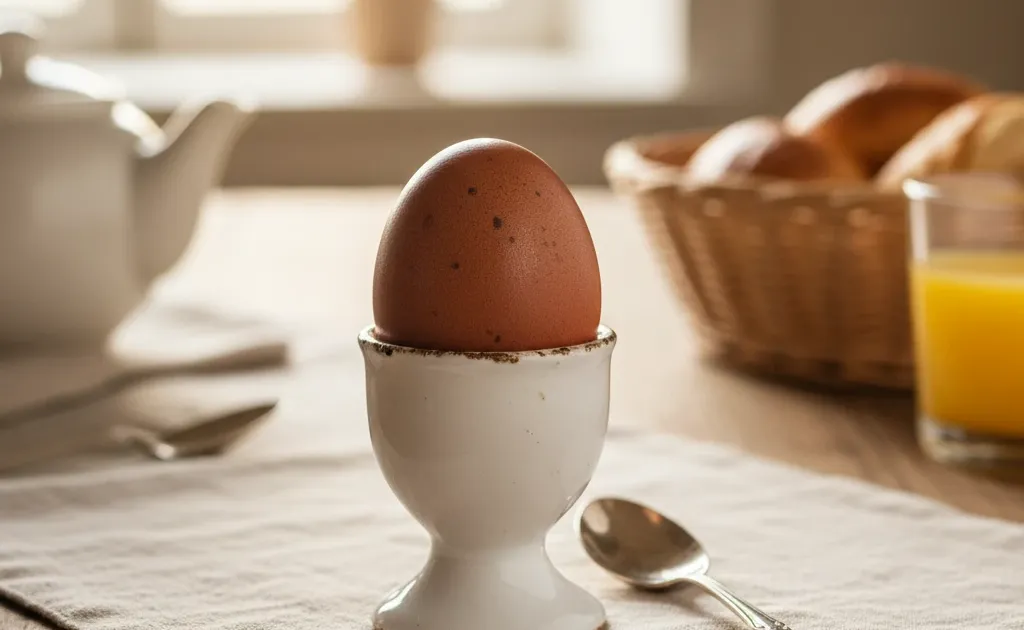
- Soft-Boiled Service: These should be served hot, nestled in a porcelain egg cup. Using a sharp knife or a dedicated egg-topper, remove the “crown” of the shell. Season with sea salt and cracked black pepper, and enjoy directly from the shell by dipping buttered sourdough “soldiers” into the liquid yolk.
- Jammy Egg Service: Once cooled and delicately peeled, these eggs are best presented halved. Their rich, fudge-like consistency makes them a superior addition to a vibrant salad, a bowl of artisanal ramen, or atop a slice of avocado toast finished with chilli flakes and extra virgin olive oil from the Lazio hills.
Conclusion: Master Your Perfect Minute
The difference between a yolk that floods the plate and one that offers a creamy, dense resistance is entirely a matter of timing. You now possess the technical framework to master both preparations with professional precision.
Do you crave the nostalgic comfort of the liquid dip? The 3-minute soft-boiled egg is your benchmark. Do you prefer a versatile, rich garnish for a sophisticated brunch? The 6-minute jammy egg will yield impeccable results.
Experiment within these parameters to find your personal “perfect minute,” and enjoy the simple, bio-available perfection of a perfectly timed egg.