Marans Eggs: The Science of the Chocolate Shell
Beyond the iconic chocolate hue, Marans eggs possess unique biochemical shell properties that ensure superior structural integrity and an extended shelf life.
Introduction: The “Chocolate Egg” and the Architecture of Preservation
In the sophisticated landscape of heritage poultry breeds, few possess the immediate aesthetic and technical prestige of the Marans. Originating from the French port town of Marans, this breed has achieved global renown for its ability to produce eggs that are, quite literally, in a class of their own. Famous for their deep, chocolate-brown pigmentation, these eggs harbour a secret that transcends their visual allure: a shell with superior physical characteristics that provide tangible, functional advantages.
This article explores the biochemical nuances of Marans eggs, deconstructing the origin of their pigment and, more importantly, the unique structural properties of their shell that render them exceptionally durable and gastronomically superior.
The Pigmentation: A Study in Deep Protoporphyrin
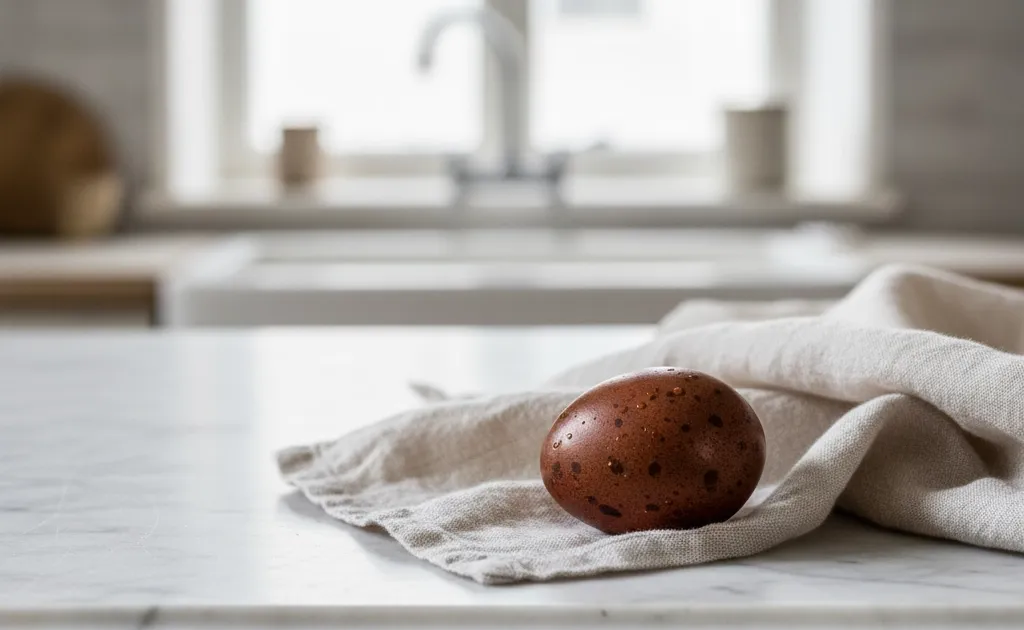
The most celebrated hallmark of the Marans egg is its chromatic depth, which ranges from an intense russet to a saturated dark chocolate—often finished with a lustrous sheen and delicate darker speckles. Connoisseurs and breeders assess this intensity using an official scale ranging from 1 (near-white) to 9 (deep mahogany). Premium Marans specimens typically achieve levels between 5 and 7 on this spectrum.
This rich coloration is the result of a high-concentration deposition of the pigment protoporphyrin IX. Unlike other breeds, the Marans hen secretes this pigment in abundance during the terminal stages of the shell’s transit through the oviduct. It is applied as a heavy, mucus-based “pigmentary glaze” or cuticle just before oviposition. This thick, tinted layer is what confers the egg its sought-after “chocolate” identity.
The Structural Secret: An “Armoured” Shell Matrix
Beyond the chromatic appeal, the true technical excellence of Marans eggs lies in the physical density of the calcium carbonate matrix. Through targeted genetic lineage, this breed has been refined to produce eggs with an exceptionally thick and robust shell. This structural tension is immediately apparent to the touch; the egg feels weightier and possesses a higher degree of physical resistance.
Crucially, this shell exhibits a significantly lower micro-porosity compared to standard commercial eggs. While all avian shells are permeated by thousands of microscopic pores to facilitate gas exchange, the Marans shell features smaller and less frequent apertures. This dense, “armoured” architecture is not merely a curiosity—it is the foundation of the egg’s superior preservation capabilities.
Practical Advantages: Robustness, Longevity, and Bio-Security
The unique structural properties of the Marans shell translate into concrete advantages for the discerning consumer and the premium producer.
Superior Structural Integrity
The increased shell thickness renders the egg far less susceptible to micro-fractures and accidental breakage. This robustness is a significant asset during collection, domestic handling, and transit, ensuring the internal contents remain hermetically sealed until the moment of culinary execution.
Extended Shelf Life and Freshness
Reduced porosity is the biochemical secret behind the Marans’ legendary longevity. A less porous shell acts as a more formidable barrier against the external environment, yielding two primary effects:
- Retarded Desiccation: It significantly limits the evaporation of moisture and the loss of carbon dioxide from the interior. This process is the primary driver of egg senescence (where the albumen thins and the air cell expands). By slowing this transition, the Marans egg maintains its “as-laid” freshness for a considerably longer period.
- Enhanced Pathogen Prophylaxis: The dense shell matrix more effectively obstructs the potential ingress of external bacteria, such as Salmonella. This provides an inherent layer of microbiological security.
Owing to these properties, Marans eggs enjoy an extended shelf life that far exceeds that of most conventional or Mediterranean breeds.
Culinary Implications
While flavour is largely dictated by the “terroir” of the pasture and the hen’s diet, many gourmets prize Marans eggs for their yolk density. The prolonged freshness and structural tension of the albumen make them the gold standard for poached preparations, fried eggs, and raw applications where the integrity of the protein matrix is paramount.
Conclusion: Functionality Beneath the Aesthetic
Marans eggs serve as a perfect example of how heritage genetics can optimise functional characteristics far beyond simple aesthetics. Their shell is not merely an attractive casing; it is a natural piece of bio-engineering, optimised for protection, safety, and prolonged preservation. To select a Marans egg is to appreciate more than just its unique beauty—it is to choose a product defined by its superior structural robustness and an innate ability to maintain peak freshness and safety over time.