Assessing Egg Freshness: 4 Scientifically Proven Methods
Is your egg still fresh? Domestic protocols to evaluate biochemical integrity and culinary performance.
Introduction: Why Does Egg Freshness Matter?
You discover a carton of eggs at the back of the refrigerator, and the ‘best before’ date is either illegible or fast approaching. This presents a classic culinary dilemma: are they still fit for consumption? The freshness of an egg is not merely a detail for gastronomic purists; it is a critical factor impacting three fundamental pillars: flavour profile, functional culinary performance, and, most importantly, microbiological safety.
A fresh egg possesses a richer flavour and superior structural tension. In the kitchen, its functional yield is significantly higher: the thick, viscous albumen of a fresh egg is capable of being whisked into more stable, voluminous peaks, ensuring the success of soufflés and meringues. Conversely, an aged egg has a watery albumen that struggles to sequester air.
From a safety perspective, while the shell provides an extraordinary natural barrier, its porosity increases over time, rendering it more permeable to external pathogens. Understanding how to assess freshness ensures both the success of your recipes and peace of mind at the dining table.
Fortunately, one does not need a laboratory to evaluate an egg. There are domestic methods, rooted in sound physical and biological principles, that are swift, effective, and reliable. Let us explore them.
Method 1: The Water Immersion Test (Hydrostatic Balance)
This is the quintessential benchmark for freshness—highly reliable and scientifically grounded. It operates on a simple physical principle related to the “air cell” within the egg.
The Science Behind the Test: The eggshell is a semi-permeable membrane with thousands of microscopic pores. Post-oviposition, as the egg cools, a small air pocket forms between the membranes at the blunt end. As the egg ages, moisture evaporates through the pores and is replaced by air. Consequently, the air cell expands, reducing the egg’s overall density and increasing its buoyancy.
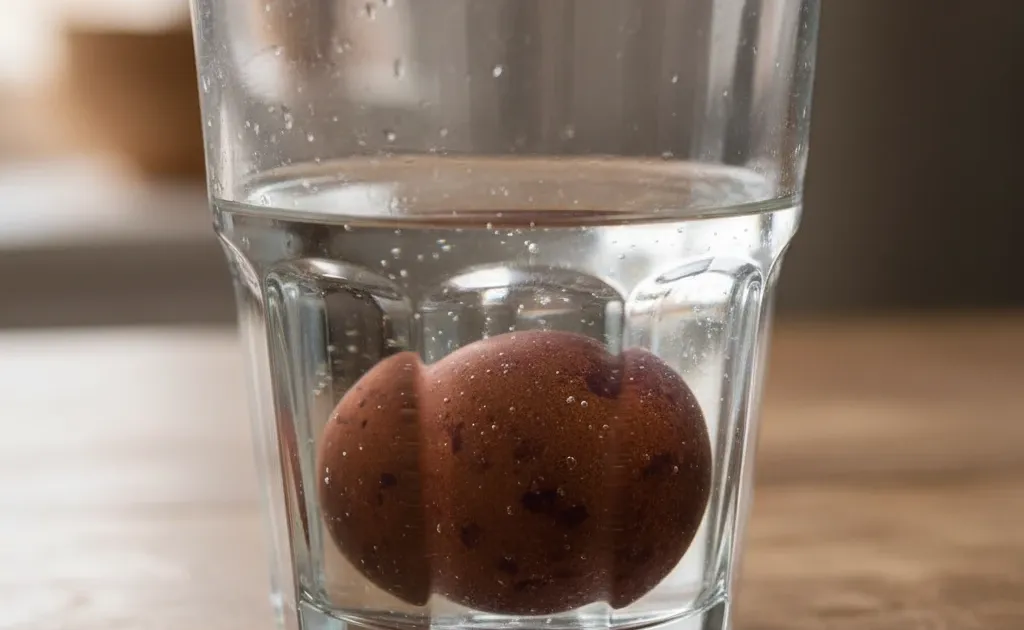
To perform this test, fill a tall, transparent vessel (such as a large glass or carafe) with cold water. Gently submerge the egg and observe its orientation.
Here are the four potential outcomes:
-
The egg sinks and rests horizontally on the bottom.
- Verdict: EXTRA FRESH. The air cell is minimal. The egg is perfect for all applications, including raw preparations such as tiramisu, mayonnaise, or an authentic Carbonara.
-
The egg sinks but tilts slightly, with the blunt end rising.
- Verdict: FRESH. The air cell has begun to expand. The egg is approximately 1–2 weeks old. It remains excellent for standard use, particularly for boiling, frying, or omelettes.
-
The egg touches the bottom but remains “standing” vertically.
- Verdict: STALE. The air cell is large enough to shift the centre of gravity. The egg is likely 3–4 weeks old. Its flavour profile has diminished, and its structural integrity is compromised. It should only be consumed if thoroughly cooked (e.g., hard-boiled or in baked goods).
-
The egg floats entirely on the surface.
- Verdict: EXPIRED – DISCARD. The air cell is so large that the egg is less dense than water. This is an unequivocal sign that the egg is no longer edible and must be discarded immediately. Remember the golden rule: fresh eggs sink; aged eggs float.
Method 2: Morphological Inspection (The Break-Out Test)
If you have already cracked the egg, your eyes are an excellent diagnostic tool. The biochemical differences between fresh and aged eggs are stark. Break the egg onto a flat surface, such as a white plate.
-
Extra Fresh Egg:
- Yolk: Appears turgid, high, and dome-like. Its colour is vibrant, and it remains perfectly centred. A compact yolk with high vitelline membrane strength is the primary indicator of quality.
- Albumen: Clearly differentiated into two zones. An inner, thick, gelatinous section (the chalaziferous layer) that tightly grips the yolk, and an outer, thinner liquid section. In a fresh egg, the thick albumen is predominant.
-
Aged Egg:
- Yolk: Appears flattened, spread out, and fragile. It breaks easily and fails to remain centred.
- Albumen: Almost entirely liquid and watery, spreading extensively across the plate. The structural proteins have denatured, and the thick albumen is virtually non-existent.
If upon opening the egg you detect a pungent, sulphurous, or “off” aroma, discard it immediately. Your olfactory sense is a primary safety sensor.
Method 3: The Acoustic Test
This is a rapid method useful when a water vessel is unavailable. While less precise than the immersion test, it provides a valuable preliminary indication.
- The Technique: Hold the egg close to your ear and shake it gently.
- What to Listen For:
- Silence: If no sound is detected, this is an excellent sign. In a fresh egg, the viscous albumen and firm yolk occupy the entire internal volume, preventing movement.
- A “sloshing” sound: If you hear a liquid sound, it indicates the egg is no longer fresh. This sound is produced by the thinned yolk and albumen moving against the shell within the enlarged air cell. The louder the sound, the older the egg.
Method 4: Domestic Candling (Transillumination)
Candling is the professional technique used in industrial grading to inspect the internal contents. You can replicate this at home quite easily.
- The Technique: In a darkened room, use a high-intensity torch (the LED on a smartphone is sufficient). Place the torch against the blunt end of the egg to illuminate the interior.
- What to Observe:
- Fresh Egg: The interior will appear full, with a very small air cell at the top (no more than a few millimetres deep). The yolk will appear as a faint, stationary shadow.
- Aged Egg: The air cell will be distinct and large. The yolk shadow may appear darker and more mobile, moving freely within the thinned albumen.
Conclusion: Eliminating Uncertainty
The next time you encounter an egg of uncertain age, do not leave it to chance. You are now equipped with four scientifically sound methods—simple yet definitive—to verify its freshness in seconds.
From buoyancy tests to morphological analysis, you have the tools to ensure flavour, culinary success, and safety for your household. With practice, assessing an egg’s integrity will become an intuitive part of your culinary routine.